
An alcohol free St Patrick’s Day is possible, even if it may not feel that simple. More people than you might expect choose not to drink on St Patrick’s Day, for all kinds of reasons. Some are in recovery. Some are cutting back. Some are pregnant, on medication, or simply do not want to drink. St Patrick’s Day is one of the most widely celebrated days in Ireland, known for its music, parades and community gatherings, and all of that is available to you without alcohol. When drinking is so closely associated with the celebrations, choosing not to drink can feel like stepping outside the tradition, perhaps it is even your first St Patrick’s Day sober. With the right preparation, the day can still be meaningful and enjoyable.
Why St Patrick’s Day can be challenging in recovery
HSt Patrick’s Day is one of the most alcohol-saturated days in the Irish calendar. According to Business World Ireland, 47% of Irish adults expect to drink on St Patrick’s Day. That means choosing not to drink puts you in the minority, and that comes with its own social pressure, whoever you are and whatever your reason.
The data reflects a broader pattern. According to the National Self-Harm Registry Ireland, St Patrick’s Day generates more hospital self-harm presentations than any other public holiday in the country. On an average day there are around 27 presentations. On St Patrick’s Day that figure rises to 44, an increase of over 60%. Alcohol was involved in 43% of those presentations.
Clinicians link this pattern to the combination of higher alcohol consumption, disrupted routine and high-pressure social occasions. Your brain associates familiar settings and social situations with past drinking, which is why a St Patrick’s Day parade can feel harder than an ordinary day. Finding the day hard is predictable, but it does not have to mean your recovery is at risk.
Keith Cassidy, Clinical Manager at Smarmore Castle, works with people in recovery around this period every year.
“What we know, from years of working in addiction treatment, is that unplanned situations and high-pressure social occasions are among the most common triggers for people who have struggled with alcohol dependence. A little preparation genuinely makes a difference, not to dampen the celebration, but to make sure people can actually enjoy it.”
Celebrating St Patrick’s Day without alcohol
Staying sober during the St Patrick’s Day celebrations is achievable. Whether this is your first alcohol-free St Patrick’s Day or one of many, the experience tends to be different from what people expect. Many find it becomes one of the more memorable ways to mark the holiday. There is the opportunity to create new traditions and experience a different joy in the day.
As Keith puts it: “St Patrick’s Day celebrates Irish music, literature, heritage, and the sense of community that defines this country at its best. None of that requires alcohol to be at the centre of it.”
Alcohol has become so central to the celebrations that opting out can feel like opting out of belonging. That pressure is real. Deciding in advance how you want to approach the day is what makes it manageable.
Tips for an alcohol free St Patrick’s Day
Plan ahead for social events
Before you go anywhere, whether the parade in Dublin or a comedy night in Cork, take a moment to think about who will be there and what situations might be challenging. Plan what you might say if someone offers you a drink. If you need to leave early, you can always leave.
Consider whether a particular event is worth attending at all. Some environments will put you under more pressure than others. A bar or pub can be more difficult to navigate than a walking tour or art festival, but only you know where you would feel most comfortable.
Spend time with supportive people
Think about who in your life you can be honest with about how you want to approach the day. A friend, family member or colleague who knows your intentions can make a real difference.
If you are in recovery, reach out to your sponsor or a peer before the day arrives. Let them know it is coming and ask someone to be available if you need to talk. They may also have insights to share and experiences to relate to. As Keith notes, reaching out often helps the person you are calling too, not just you.
Choose alcohol-free activities
There are such a wide range of events in Ireland, on St Patrick’s day. If the events you usually attend are heavily drink-focused, this is a good year to explore alternatives.
A growing number of venues across Ireland now offer alcohol-free options, including non-alcoholic beers, mocktails and soft drinks that have improved considerably in recent years. You do not have to avoid social spaces entirely to have an alcohol free St Patrick’s Day.
Seek out support if you need it
If you are finding the day difficult, support is available. Talk to your GP, contact a trusted person in your life, or reach out to a support service.
If you attend 12 Step meetings, online groups run around the clock and across every time zone. If the group you usually attend is not meeting on the day, there will be another one that is. Other structured support options are available if 12 Step is not the right fit for you. Your keyworker or aftercare team at Smarmore Castle can help you find what works.
Alcohol-free ways to celebrate St Patrick’s Day
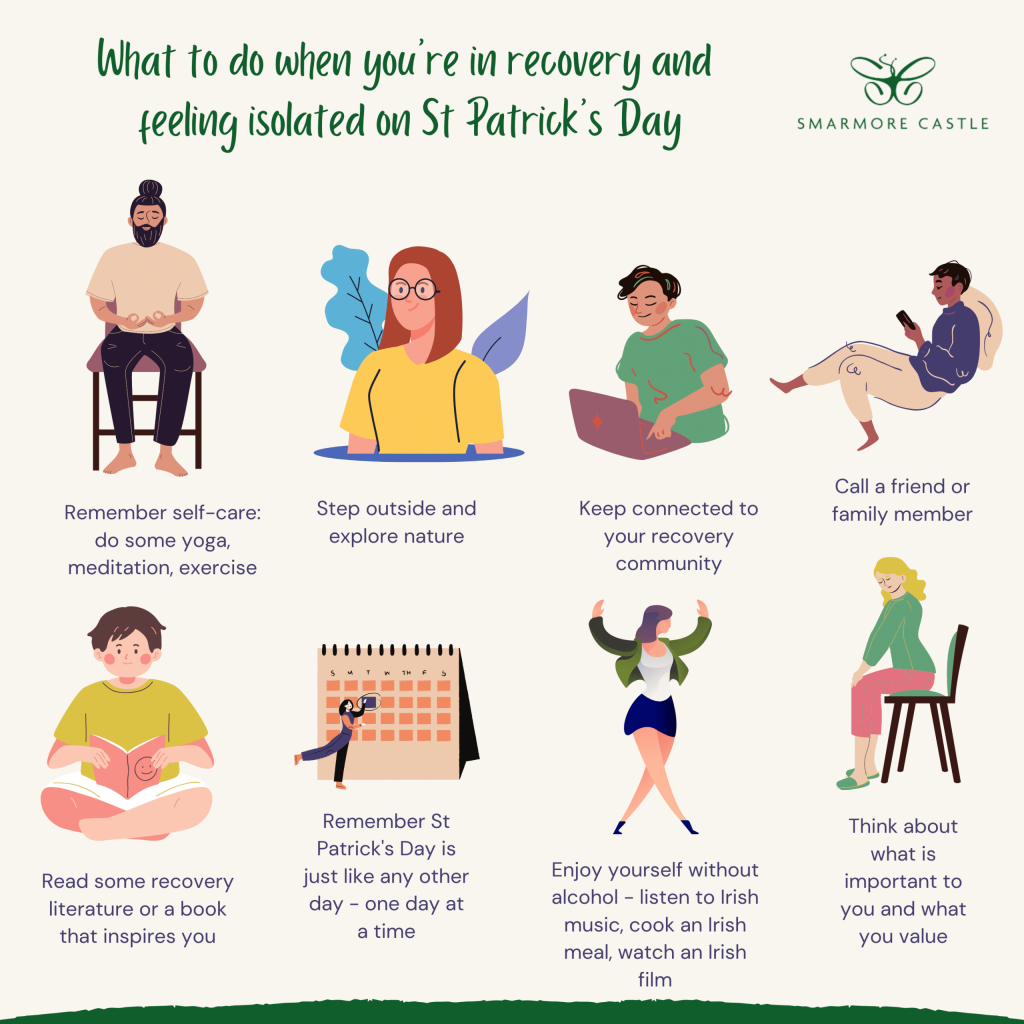
Ireland’s national day has a cultural depth that does not require alcohol and there are several options worth considering:
- Attend a local parade or community event.
- Go to a traditional music session and stay for the music.
- Cook an Irish meal at home with family or friends.
- Visit somewhere in Ireland you have not been before.
St Patrick’s Day is so culturally rich, that it is about more than drinking. Experiencing it that way is something anyone can choose.
When the holiday feels difficult
If St Patrick’s Day brings up something bigger, such as a craving that feels too challenging to manage or a sense of feeling overwhelmed, please seek support before things escalate.
You do not need to have relapsed to call us. If the March festivities in Ireland are feeling like a struggle, that is enough.
Getting support early, before alcohol use becomes a crisis, can make a real difference to your recovery. Reaching out is not overreacting.
If you do drink on St Patrick’s Day, that does not mean your recovery is over. One difficult day is not the end of the journey. What matters is what you do next. Contact your support network, attend a meeting, or call Smarmore Castle. Reaching out after a setback is one of the most important things you can do.
If you are in immediate distress, contact the Samaritans, a free listening service available 24 hours a day, on 116 123.
Recovery support at Smarmore Castle
If St Patrick’s Day is making you aware that your relationship with alcohol needs attention, that awareness matters.
Smarmore Castle offers residential treatment and aftercare for people with alcohol use disorder. Our addiction treatment programmes are designed around the individual, not a one-size-fits-all model. If you are ready to talk about next steps, our admissions team is here.
Call the team at Smarmore Castle for confidential advice about alcohol addiction treatment and recovery support: +353 41 214 5111.
This article is written by Keith Cassidy, Manager at Smarmore Castle Rehab Clinic, County Louth, Ireland.
Frequently asked questions
-
Can you celebrate St Patrick’s Day without alcohol?
Yes. The traditions associated with St Patrick’s Day, such as parades, music, food and community, exist entirely apart from alcohol. Many people across Ireland celebrate the day without drinking, including a growing number who choose alcohol-free options as a matter of preference rather than recovery.
-
How do people in recovery handle St Patrick’s Day?
Most people in recovery handle St Patrick’s Day by planning ahead. This means knowing which events they will attend, having a support contact available, attending a meeting if needed, and building the day around activities that do not centre on alcohol. Preparation is what makes the difference.
-
What are alcohol-free St Patrick’s Day activities?
Parades, traditional music sessions, coastal walks, meals with family and community events are all part of how Ireland marks the day. Alcohol-free and low-alcohol drinks are increasingly available in pubs and bars across the country, making it easier to take part in the social occasion without drinking.
-
What should I do if I feel tempted to drink?
Contact someone from your support network straight away. If you attend 12 Step meetings, find one online. If you are an alumnus of Smarmore Castle, call our aftercare team. You can also contact your GP or the HSE’s alcohol support services. If you feel you cannot manage alone, call the Samaritans on 116 123. You do not need to wait until things reach a crisis point.