

Post-Treatment Support

Leaving rehab is a significant step in your recovery. Adjusting to life after rehab support at home takes time. You have worked through some important milestones as part of your treatment, but completing your residential stay isn’t the finish line.
Smarmore Castle’s continuing care programme is built on more than 40 years of addiction treatment expertise. After residential rehab ends, our team continues to work with you and your loved ones. Together, we focus on rebuilding your health and wellbeing at home. Our team is here whether you need therapy, help managing relationships, or simply someone to talk to when things become challenging.
Our continuing care programme is designed to support you at whatever stage you are at in your recovery.
Why continuing care matters after rehab
The first few weeks after leaving treatment can feel challenging. The routine of treatment that held your days together is gone. Home looks the same as it always did, but you don’t quite feel the same inside it.
That adjustment is normal. It is also exactly what continuing care is designed for.
In the relapse prevention group, you sit with people who have recently finished treatment at Smarmore Castle. Some have already been at home for a few weeks. Others have been attending the group for months.
What gets discussed isn’t abstract theory. It’s the specific pressures of the week just gone: a difficult conversation with a partner, a situation at work that felt harder than expected. It could also have been a moment where the urge to use came back stronger than anticipated. The group works through those moments together, drawing on the relapse prevention techniques from residential treatment. The aim is to understand what actually works when you’re back at home.
Being in a room, or on a call, with people who genuinely understand what that week felt like makes a difference. Not because they’ve read about it, but because they’ve lived it.
What happens after leaving rehab?
Before you leave Smarmore Castle, your clinical team will put together a personalised continuing care plan. This sets out the support that is right for you. It reflects your time in treatment, your home situation, and your recovery goals.
Your plan is built around your circumstances and may combine group therapy, one-to-one sessions, and family support. No two plans are the same, because no two recoveries are the same.
We will also connect you with your GP or the medical practitioners involved in your care before treatment. Where appropriate, we arrange a contact within local Alcoholics Anonymous (AA) or Narcotics Anonymous (NA) fellowship groups, so you have peer support after rehab within your community.
Continuing care at Smarmore Castle
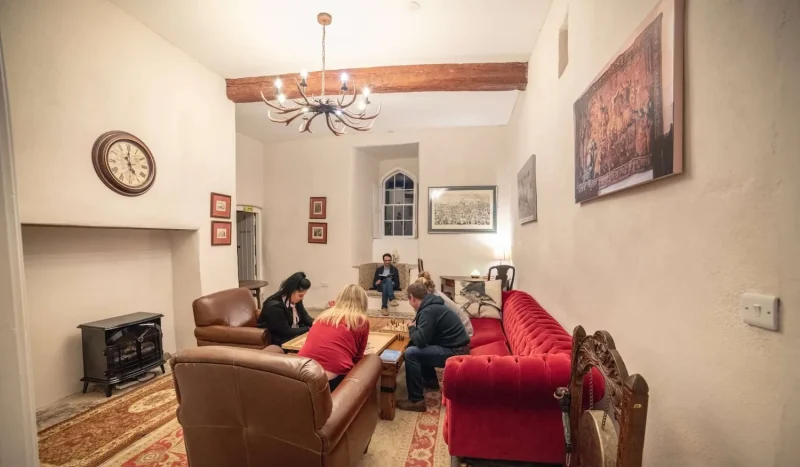
Personalised continuing care plan
Your continuing care plan is designed around you, what works for you, and what doesn’t. It reflects where you are now and what your life outside treatment actually looks like. Your plan is reviewed as your recovery progresses.
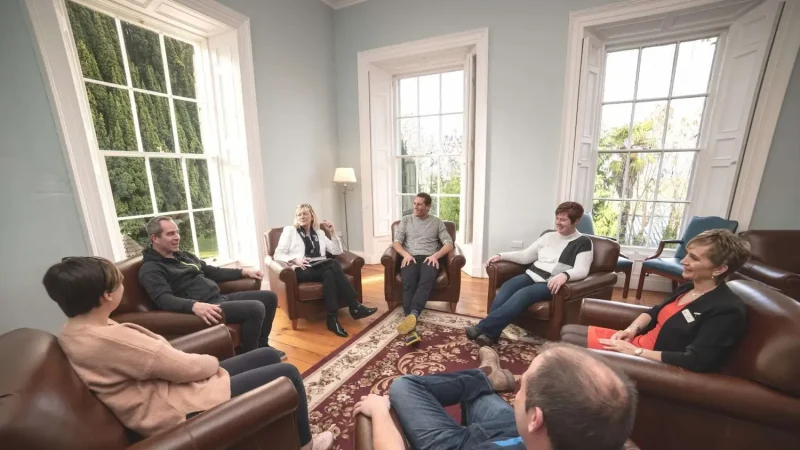
Group therapy and relapse prevention
All patients are invited to join our Saturday morning group focused on relapse prevention. The group is led by a therapist and focuses on the relapse prevention techniques you developed during treatment, and how to apply them in real situations.
The group is free of charge. It runs on an ongoing basis. You are welcome to attend for as long as it is useful to you.
12-month continuing care programme
For those who want more structured addiction recovery support, we offer a 12-month group therapy programme. Groups are small and consistent. You will attend with the same people throughout, so trust can be built over time.
Sessions are available in person at Smarmore Castle and our Castle Health clinic in Dublin city centre, and via Zoom. Whatever your schedule or location, you can stay connected to your continuing care group.
Smarmore Castle provides an abstinence-based programme. Maintaining that in a group setting protects the recovery of every member, including yours. Payment plan options are available to help with access.
Family involvement and support
Recovery affects the whole family. The people closest to you have been on their own journey, and continuing care gives them a place in yours.
Family members who attended our family therapy programme during your time in treatment are welcome to join a continuing care group for family members. Alternatively, they can join your group as a concerned person, depending on what works best for everyone involved.
If you are a family member reading this, our team can talk through what continuing care might look like for you. Find out more about Smarmore Castle.
Online and in-person sessions
We know that geography, work, and family commitments do not disappear when treatment ends. Our continuing care programme is designed to be flexible. Sessions are available in person at Smarmore Castle and Dublin city centre, and via Zoom for those who cannot attend in person.
If our groups aren’t easily accessible where you are, we can arrange one-to-one tele-therapy. This supports you through the early weeks and months of recovery. Our team will also work to identify local resources in your area, whether free or paid.
One-to-one therapy options
Private individual therapy is available through Castle Health’s outpatient services. All therapists are qualified and experienced in addiction aftercare. Sessions are available in person and via Zoom.
If you need more focused support than a group provides, one-to-one therapy is available. It can run alongside your continuing care group or as a standalone option. Speak to our team about what is available and how to access it.
“It was great have this service after I was in treatment the follow up therapy was a huge boost to my recovery.” – Monkey (5 star rating on Google).
Relapse prevention and ongoing support
Relapse is part of many people’s recovery journeys. It does not undo what you have already built. If you experience a relapse, Smarmore Castle’s Relapse Re-entry Group offers a direct route back into structured support. At Smarmore Castle, the Relapse Re-entry Group runs for a minimum of six weeks. It gives you space to understand what happened and to process it without shame. It will also help you to develop practical strategies to move forward.
Once you are stable, you can rejoin the main continuing care group. The pathway back is clear, and it is always open.
How long should continuing care last?
Many HSE-supported programmes provide up to 12 months of aftercare, and long-term support beyond that is common. What matters is that your continuing care is matched to where you are in your recovery.
Some people need intensive support in the first few months and taper gradually. Others find that a weekly group remains valuable for years. Your continuing care plan will reflect what is right for you.
Can continuing care reduce relapse risk?
Long-term peer support and professional oversight offer you a stronger foundation for life after residential treatment. Engaging with continuing care is a practical step that supports your recovery.
How to access continuing care
Continuing care at Smarmore Castle is discussed with you before you leave treatment. If you have already completed treatment and want to access continuing care, or if you are a family member looking for support, our team can help.
Frequently asked questions
-
What is continuing care in addiction treatment?
Continuing care is the support you receive after leaving residential treatment. It can include group therapy, one-to-one sessions, relapse prevention groups, and family support. At Smarmore Castle, continuing care is part of how we approach recovery, not a separate service.
-
Do I need continuing care after rehab?
Most people benefit from some form of continuing care after residential treatment. The transition back to everyday life brings real challenges, and having support during that time helps improve recovery outcomes. Your clinical team will discuss what is right for you before you leave.
-
How long does continuing care last?
Many HSE-supported programmes provide up to 12 months of aftercare, and long-term support beyond that is common. At Smarmore Castle, we offer a structured 12-month group therapy programme, with ongoing support available beyond that for those who need it.
-
What happens if I relapse?
If you are experiencing a medical emergency, please contact your GP or call 112 (or 999 in Northern Ireland) immediately before reaching out to us. A relapse does not mean your recovery is over. Our Relapse Re-entry Group offers immediate support led by a psychotherapist.
At Smarmore Castle, the group runs for a minimum of six weeks. It gives you a clear pathway back into continuing care.
Schedule Your Assessment
If you or a loved one are struggling, our team is here to help – contact us in confidence today.