
New figures from the UK’s Office for National Statistics confirm Northern Ireland recorded its highest rate of alcohol-specific deaths in two decades in 2024 – and is the only part of the UK still moving in the wrong direction.
Every year, the Office for National Statistics publishes a bulletin that most people never see. It records the number of people across the UK who died from causes directly attributable to alcohol – not deaths where alcohol was a factor, but deaths where alcohol was the cause. Conditions like alcoholic liver disease, alcoholic cardiomyopathy, alcohol poisoning. Deaths that, by definition, would not have happened without alcohol dependency.
The 2024 bulletin, published on 11 May 2026, contains data that raised concerns here at Smarmore Castle. In Northern Ireland, 397 people died from these causes last year. That is a 20-year record. And unlike every other part of the UK, where the rate fell in 2024, Northern Ireland’s rate went up.
We want to explain what this data means, why we think Northern Ireland finds itself in this position, and what it means for anyone in Northern Ireland who is worried about their own drinking or the drinking of someone they love.
Alcohol Deaths in Northern Ireland: The 2024 Statistics Explained
The ONS measures alcohol-specific deaths using age-standardised rates, which allows fair comparison between regions with different population sizes and age profiles. In 2024, Northern Ireland’s rate was 21.4 deaths per 100,000 people – its highest in at least 20 years, and higher than any other UK nation, including Scotland, which has long been regarded as the most acutely affected.
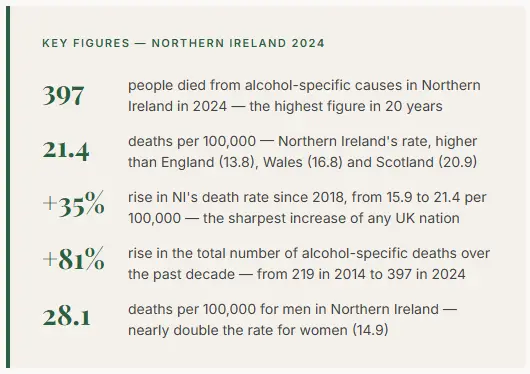
To put the 35% rise in context: across the UK as a whole, alcohol-specific death rates rose sharply during and after the pandemic, before beginning to fall back in 2024. England, Scotland and Wales all recorded lower rates in 2024 than in 2023. Northern Ireland did not. It is the only UK nation where the rate is still rising and the only one where 2024 represented a record high rather than a step back from the peak.
It is also worth being clear about what these figures do not include. Alcohol-specific deaths count only those conditions caused entirely by alcohol. They do not include the many thousands of deaths each year where alcohol is a significant contributing factor – road traffic accidents, certain cancers, heart disease, suicide. The true toll of alcohol on lives in Northern Ireland is considerably larger than these numbers suggest.
Why Is Northern Ireland’s Alcohol Death Rate Still Rising?
There is no single explanation, but several factors appear to play a role.
The pandemic accelerated existing patterns. Northern Ireland already had a rising death rate before Covid-19. The pandemic with its prolonged periods of isolation, closure of community supports, and increased at-home drinking accelerated those trends significantly. The data suggests Northern Ireland has not yet recovered from that acceleration in the way that England and Scotland have.
Deprivation is a major driver. The ONS is clear that people in the most deprived communities across the UK are between three and four times more likely to die from alcohol than those in the least deprived areas – despite evidence suggesting they do not necessarily drink more. The relationship between poverty, trauma, mental ill-health and alcohol dependency is well established. Northern Ireland has significant concentrations of socioeconomic deprivation, particularly in Belfast and Derry, which record the highest local death rates within the region.
Treatment access remains limited. Northern Ireland has one of the smaller residential rehabilitation footprints in the British Isles relative to need. NHS waiting times for alcohol treatment can be long, and many people do not access residential care, which evidence consistently shows produces the best outcomes for severe dependency, until their condition is at an advanced stage. By the time someone reaches the point of alcoholic liver disease, the most common cause of alcohol-specific death, the window for effective intervention has often narrowed significantly.
Stigma delays help-seeking. Despite genuine progress in public attitudes toward addiction, stigma remains a significant barrier. Many people with alcohol dependency do not identify as “alcoholic”, a word that carries heavy cultural weight, and do not seek treatment because they do not recognise the severity of their situation, or because they fear judgement from their community, their employer, or their family.
Alcoholic Liver Disease and Alcohol Dependency: Understanding the Link
The conditions that appear most frequently in the alcohol-specific deaths data are alcoholic liver disease, alcoholic cardiomyopathy (a form of heart muscle disease caused by chronic alcohol use), and acute alcohol toxicity. What these conditions have in common is that they develop over time. They are the result of sustained, heavy alcohol use – not occasional excess, but the kind of consumption pattern that characterises dependency.
Alcohol dependency – even severe, long-standing dependency – is treatable, and it is a tragedy that in 397 cases, treatment was not accessed in time.
Nearly 400 families in Northern Ireland lost someone to alcohol in a single year to a condition that is treatable. We see patients from across the island who have often spent years trying to manage their drinking alone before they reach us. The message we want people in Northern Ireland to hear is simple: you do not have to wait until things get worse. Effective, compassionate treatment is available – and it works.
Keith Cassidy, Clinic Director, Smarmore Castle Private Clinic


Alcohol Treatment in Northern Ireland: What Residential Rehabilitation Involves
For people with mild to moderate alcohol problems, structured support through GP services, community alcohol teams or outpatient counselling can be highly effective. But for those with severe dependency residential rehabilitation, with medically managed detox, is generally the most effective option.
At Smarmore Castle, we provide medically supervised detoxification followed by a structured residential rehabilitation programme. Detoxification from alcohol must always be medically supervised: sudden withdrawal from heavy alcohol use can be life-threatening, and attempting to detox alone at home is dangerous. Under proper medical supervision, withdrawal is managed safely, and the process of rehabilitation which involves addressing the psychological, emotional and behavioural dimensions of dependency, can begin.
Our programme draws on a range of evidence-based therapeutic approaches, including cognitive behavioural therapy, group therapy, and the 12 Step model. Patients work with a multidisciplinary team of medical staff, therapists and many staff with lived experience in recovery, over the course of their stay, and a structured aftercare plan is developed before discharge to support the transition back to everyday life.
Signs of Alcohol Dependency: When to Seek Help
Alcohol dependency does not look the same in every person, and it rarely announces itself clearly. Some indicators that alcohol use may have moved beyond occasional excess and into dependency include:
Needing to drink more to achieve the same effect; feeling anxious, irritable or physically unwell when not drinking; drinking earlier in the day than intended; being unable to stop once you have started despite intending to; continuing to drink despite consequences for your health, relationships or work; spending a significant amount of time thinking about drinking or recovering from drinking.
If any of these patterns feel familiar, whether for yourself or for someone close to you, it is worth speaking to a professional. A GP is a good starting point, but you can also contact us directly at Smarmore. A conversation is free and carries no obligation.
Getting Help for Alcohol Dependency in Northern Ireland
The data published this month should be a catalyst for that conversation. We hope it is. In the meantime, Smarmore Castle remains committed to treating every person who reaches us with the dignity and compassion their situation deserves, and to making sure that anyone in Northern Ireland who is ready to seek help knows that help is available.